
Everything I Want You to Know About Purpose
Summary
Despite living more comfortably than ever, more people than ever are struggling with loneliness and a lack of meaning. This blog explores:
Why comfort without meaning is leaving a generation feeling empty
The difference between meaning and purpose, and why both matter
What history's greatest thinkers, from Dante to Victor Frankl, understood about the human need for purpose
Why purpose is your greatest form of leverage
Two simple actions you can take today to start living with more purpose
Keep Reading
Trash collection has often been a big part of my life. I would go around the villages of North Hertfordshire picking up rubbish. It must have looked strange. I wonder if people thought I was doing community service. I wasn’t. I was paid. Unknown to the council they paid me a ridiculously good wage. They didn’t pay me by the hour, they paid me by the clean village. I worked harder and faster than they expected, so within a short period of time I had more money in my pocket than most teenagers.
Life is comfortable
Back then and still now, my life is incredibly comfortable. Yours is too. If you were born in the UK 100 years ago, there is a very high chance that you’d be working in the fields or in a factory. Instead, you’re probably working for a company and mainly using your computer to do your job. It might be mentally challenging, but there’s little risk of your computer chewing up your arm.
There are more safety nets too, the UK now spends a quarter of its GDP on social services, up from 10% in the 1950s. If we also add in all the nice things we can now have access to: smartphones, AI, low-cost airlines, it’s pretty easy to see how our modern lives are very comfortable.
The great tragedy of the 21st Century is a lack of meaning and purpose
Despite our world being easier than ever to navigate, a quarter of people globally reported feeling loneliness a lot of the day yesterday[1]. In western countries, suicide is often the number one killer for young men and women. In fact, 26% of deaths for men aged 20-34 in the UK is suicide[2].
So, despite all the comfort, why are people in the west lonely and killing themselves?
As a society, we are lacking meaning and purpose.
Meaning answers questions like: what’s the point of all of this? Why am I alive? How do I belong here?
Once we have meaning, we can think about purpose. Purpose is more future oriented – it’s about asking yourself: what do I want to contribute to the world?
Collecting trash as a teenager, my meaning was to earn some money. I didn’t have a sense of purpose. But that’s fine and healthy - I was fourteen.
I get the sense that, whilst we are living a more comfortable life, many of us are living with less meaning and purpose. The research is clear on this, having meaning and purpose leads to a longer, happier, less depressed life[3].
Asking the big questions has always been the antidote
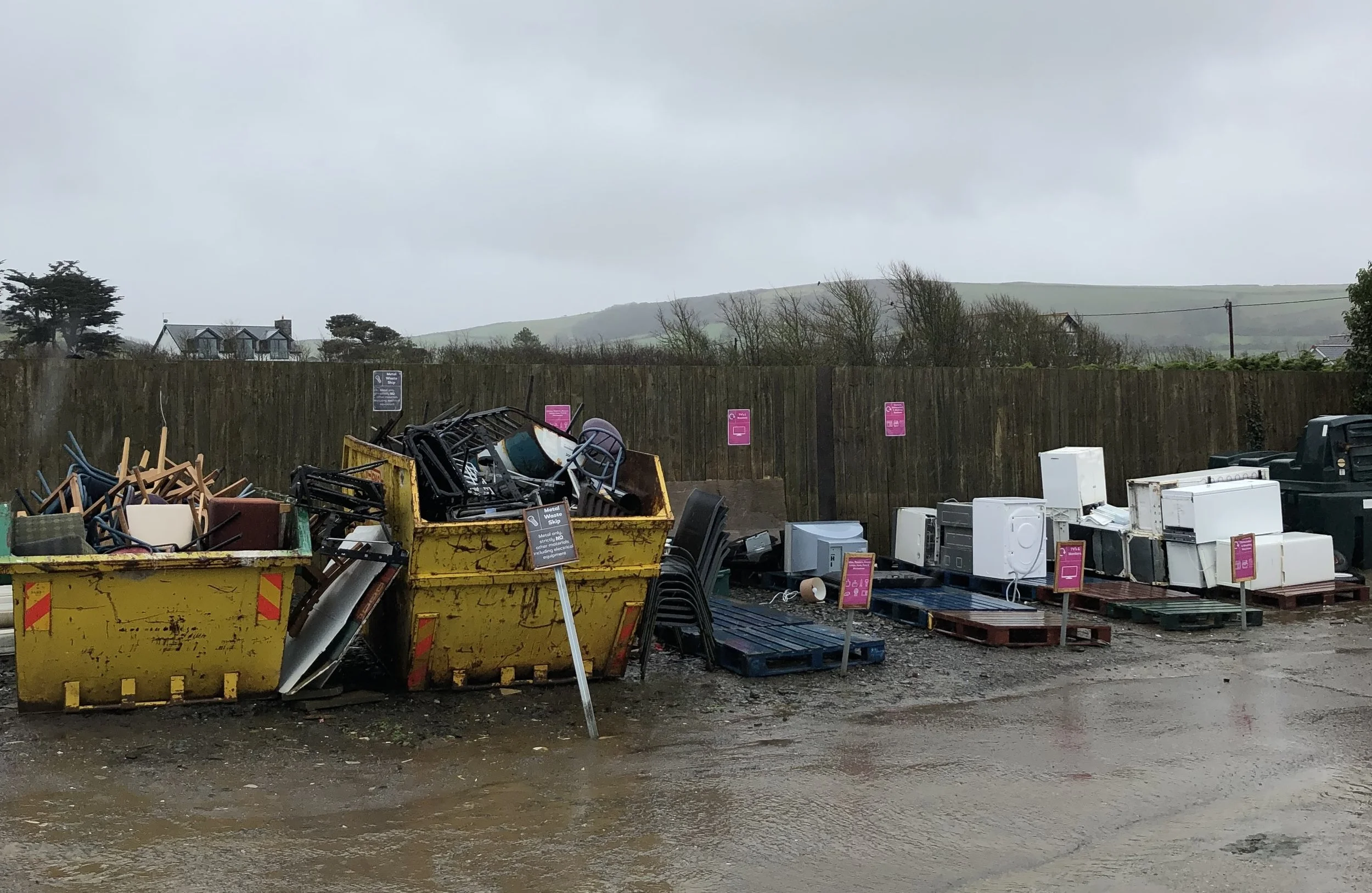
As I scrolled back through my camera roll recently, I came across this photo from 2018 on the outskirts of Newcastle.
It was a picture of a bunch of trash in a parking lot. I wasn’t fourteen and doing my trash collection job, I was there on behalf of a private equity firm, tasked with adding 2% to the bottom line by finding a cheaper supplier.
At 25, I was paid more but it didn’t give me meaning - and without meaning, we have little hope of finding purpose.
These big questions are not new. Danté wrote Inferno in the 1300s and the opening lines are centred around this very topic:
When I had journeyed half of our life’s way,
I found myself within a shadowed forest,
For I had lost the path that does not stray.
Danté’s shadowed forest was his loss of meaning and his path was his purpose.
In the 19th century, Friedrich Nietzche wrote: “he who has a why to live can bear almost any how.” He never wrote about meaning and purpose, but our 21st century framing could be: he who has a meaning to live can bear almost any purpose.
This would be documented in the most horrific circumstances by Victor Frankl in his book Man’s Search for Meaning. A Jewish psychiatrist working in Vienna, Frankl was separated from his wife and taken to Auschwitz.
He wrote about how the people who survived were those who hung onto meaning. In his case it was to go home to his wife. Whilst in the concentration camp, he crafted his theory of logotherapy: the belief that meaning – not pleasure – is the deepest human need. A need that when satisfied will help us to endure anything. Tragically, his wife never made it.
Why all the talk of purpose now?
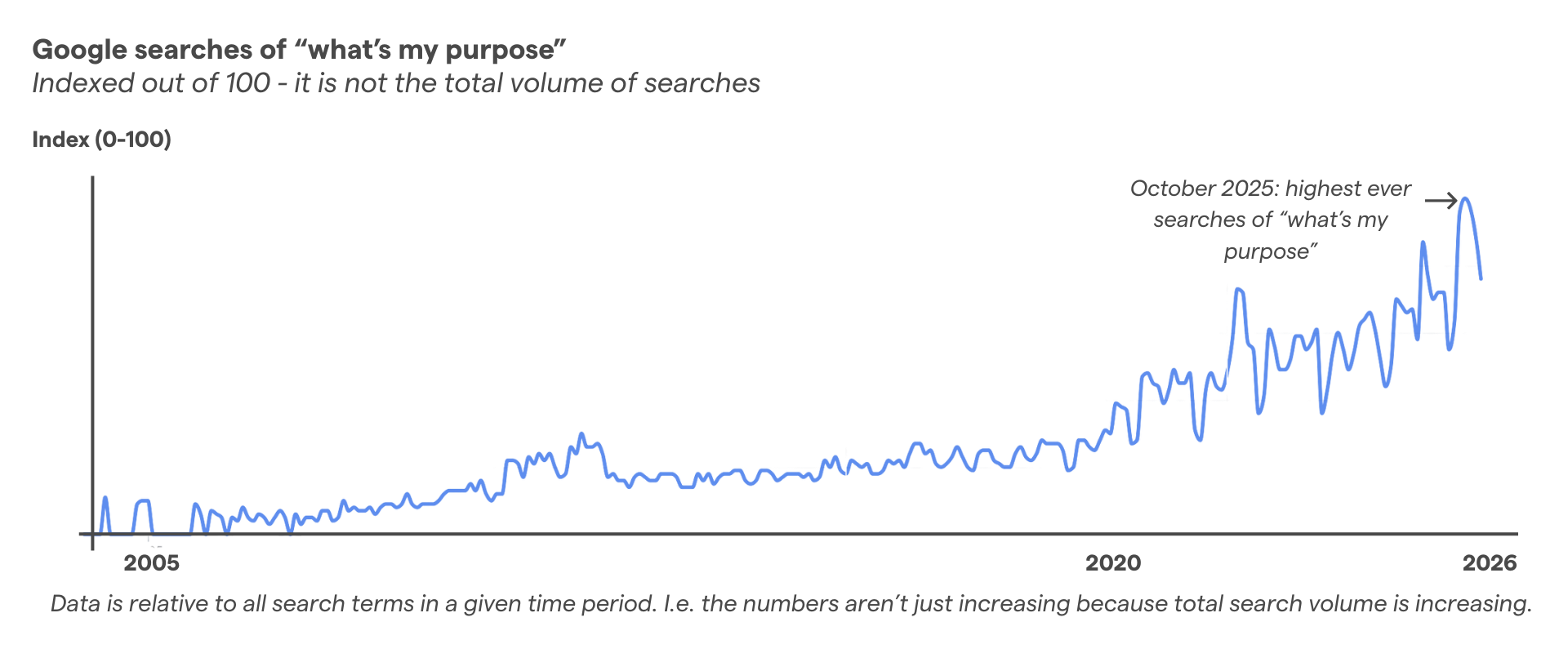
Take a look at the Google Trends data (chart below) and you’ll see that it’s not just me. “What’s my purpose” is a rising search trend – especially since the Covid pandemic began in 2020. During Covid many people were at home and those of us who were working had time to think, “is this really it?”
In the past, we would have turned to religion. Religious people consistently report[4] having more meaning in their life. They have a higher purpose. What’s changed in the last few decades is religious participation. People under 40 participate less in religion than those over 40. In the USA there is a 50% difference in participation[5].
With less religion and other societal norms breaking down, life is now more self-directed. We get to choose what we study, who we love, where we live, where we work. This is liberating, but it’s also mentally challenging to think about these introspective questions.
So what is purpose?
We said earlier that purpose is more future oriented: what do I want to contribute to the world?
Purpose is not ditching your job and running away to the hills of Bali.
Firstly, it has to involve contributing something to other people. It’s about sacrificing your time, your energy, your comfort, your pleasure, for something that transcends you – other people.
Secondly, your purpose must be something you’re passionate about. You can’t add value in something that you “sort of care about.” Not for the long term anyway.
You probably have a lot of things you care about that are taking up your mental bandwidth. It might be climate inaction, nuclear war, your relationships, instagram or food. These are like 50 open tabs on your browser.
When you lock into your purpose, it’s like you’re closing down 47 of those tabs and just leaving the three open that really matter[6]. Doing this gives you immense clarity about what’s truly important.
Your purpose is your leverage
If you still aren’t convinced by the whole purpose thing, look at it this way. You having a purpose is your greatest form of leverage.
When you deeply believe in something and take positive action to move towards it, people buy into you, they trust you, you stink of confidence, you reek of clarity, you become a magnet for people around you.
Think of any famous founder out there, they might have started their business by being smart and talented, but they turned it into a legacy, followed by thousands of employees by believing in something bigger than themselves, that’s the power of purpose.
Live a life of purpose
If we want something to change, we need to change something. We all have control over our actions.
Here are two that you can work on immediately to get closer to living a life of purpose:
Do something for someone today – remember, purpose is about contribution.
Learn something you are curious about – remember purpose is about passion, and passion comes from curiosity.
Deepen Your Curiosity
It’s referenced time and time again because it’s a classic. Victor Frankl’s Man’s Search for Meaning is a pivotal book in understanding what meaning and purpose is, and why it’s so important.
Listen to Mark Manson’s marathon episode on Solved if you want to have a nuanced view into purpose:
Want to narrow down and define your purpose? Book your 30 minute session to get started.
Or, if you want to meet like-minded individuals also trying to live with more purpose check out our events.
If you’re curious:
[1] https://news.gallup.com/poll/646718/people-worldwide-feel-lonely-lot.aspx
[3] https://pubmed.ncbi.nlm.nih.gov/24815612/
[5] https://www.pewresearch.org/short-reads/2025/09/02/how-religion-declines-around-the-world/
[6] This wonderful metaphor of computer tabs is from Mark Manson’s podcast Solved.
