
How To Find What Lights You Up
Summary
Being good at something and being energised by it are not the same thing:
The things you’re best known for at work aren’t always the things that light you up
The world rewards competence with praise, promotions and more responsibility
But build a career on competence and you’ll hit a ceiling, build a career around your strengths and the sky is the limit
A simple test tells them apart: a strength leaves you thinking “I can’t wait to do that again!” A competence leaves you thinking “thank God that’s over!”
Keep Reading
The danger of being “good” at something
Go into any office and you will find a lot of incredibly competent people. Their reviews, appraisals and every piece of feedback all say the same thing: they are excellent at what they do. And yet, they end each day feeling a little flat.
These competent people aren’t struggling because they lack ability. They are struggling because their days are spent in tasks that instead of energising them, leave them feeling drained.
Because the problem with being simply “good” at something, is that because you’re good at it, you get praised for it. You get praised, so you get given more of it. Before you know it, your whole week is full of work you’re excellent at but don’t enjoy. Sunday evenings and Monday mornings feel a little heavier than they should.
The alternative? Playing to our strengths. Engaging in activities that we are both good at and that we enjoy, that make us feel alive, that lift our soul. The kind where time flies and we come out the other side excited to do it again.
And this doesn't have to mean quitting your job and changing career. More often than not, it's about finding ways to play more to your strengths in the role or company you are already in. Finding more fulfillment, joy and energy, exactly where you are.
What is a “strength”?
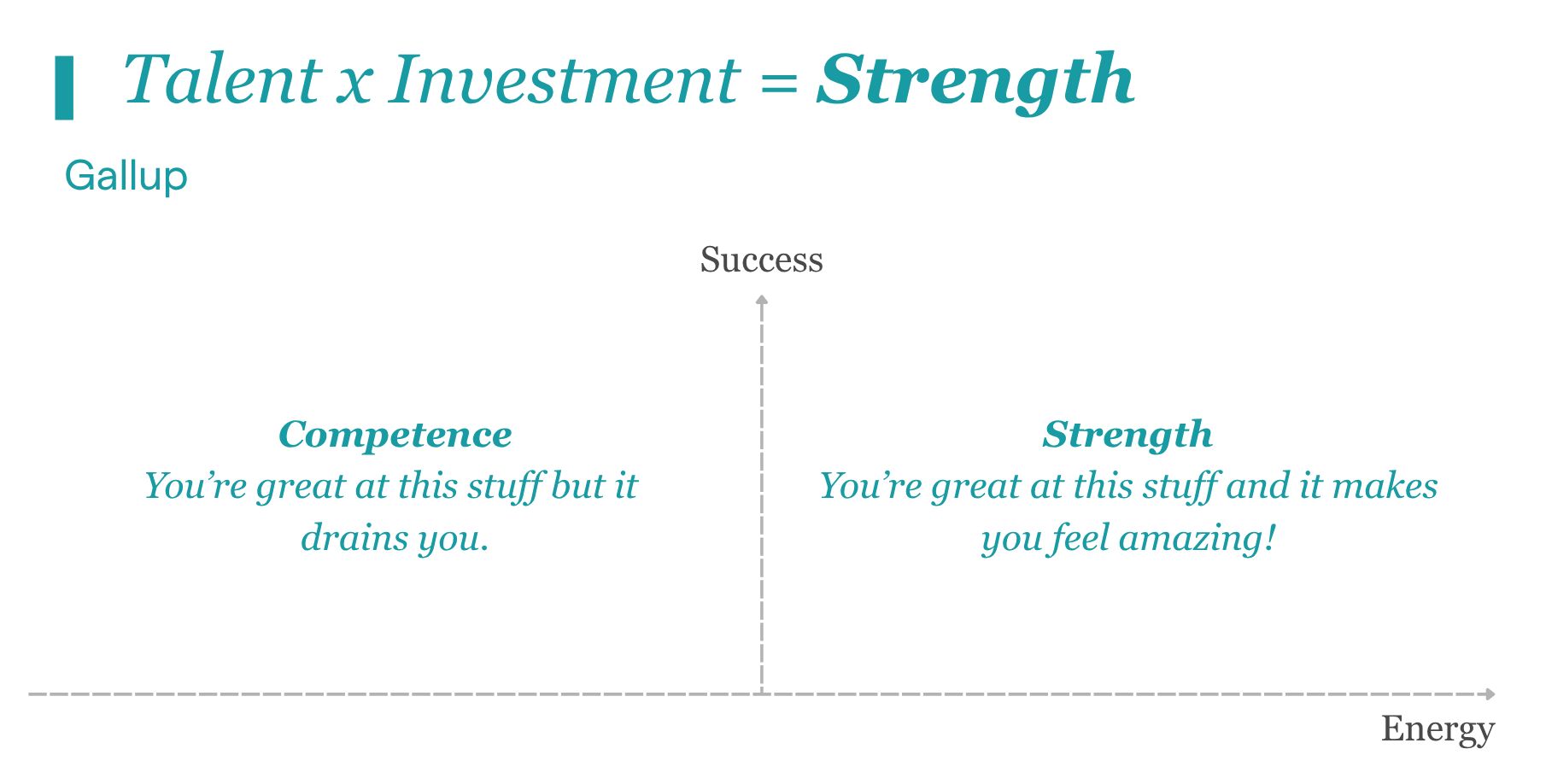
The difference between a competence and a strength.
Gallup - who have studied this across over two million people in over a hundred countries - have a formula: Talent x Investment = Strength.
A talent is a natural way of thinking, feeling or behaving. When you were a child, you were loaded with them - things that just came naturally, literally part of your DNA.
Maybe you made friends easily, were endlessly curious, or could spend hours building, drawing or creating.
As you got older, you invested time and energy in those talents (whether or not you knew they were talents at the time). That endlessly curious child became the friend always reading, then the colleague asking thoughtful questions in meetings and always learning new skills.
A strength is that combination: natural talent multiplied by investment of time, energy and attention.
The deficit model of development
So, what does the research say is the greatest opportunity to improve your performance and engagement at work (and therefore in life)? Focus on what you are already naturally great at and enjoy - and do more of it.
But here’s the problem. That is not how most of us were taught to develop, right? Think about every performance review, every school report. What did they spend most of the time on? Your strengths? Or your weaknesses?
This is the deficit model of development - the assumption, baked into almost every education system and corporate structure - that the best way to develop a person is to identify what they are bad at and fix it.
And the research shows that this is completely the wrong approach. People who use their strengths every day are 6x more likely to be engaged in their job and 3x more likely to report having an excellent quality of life.
A simple test
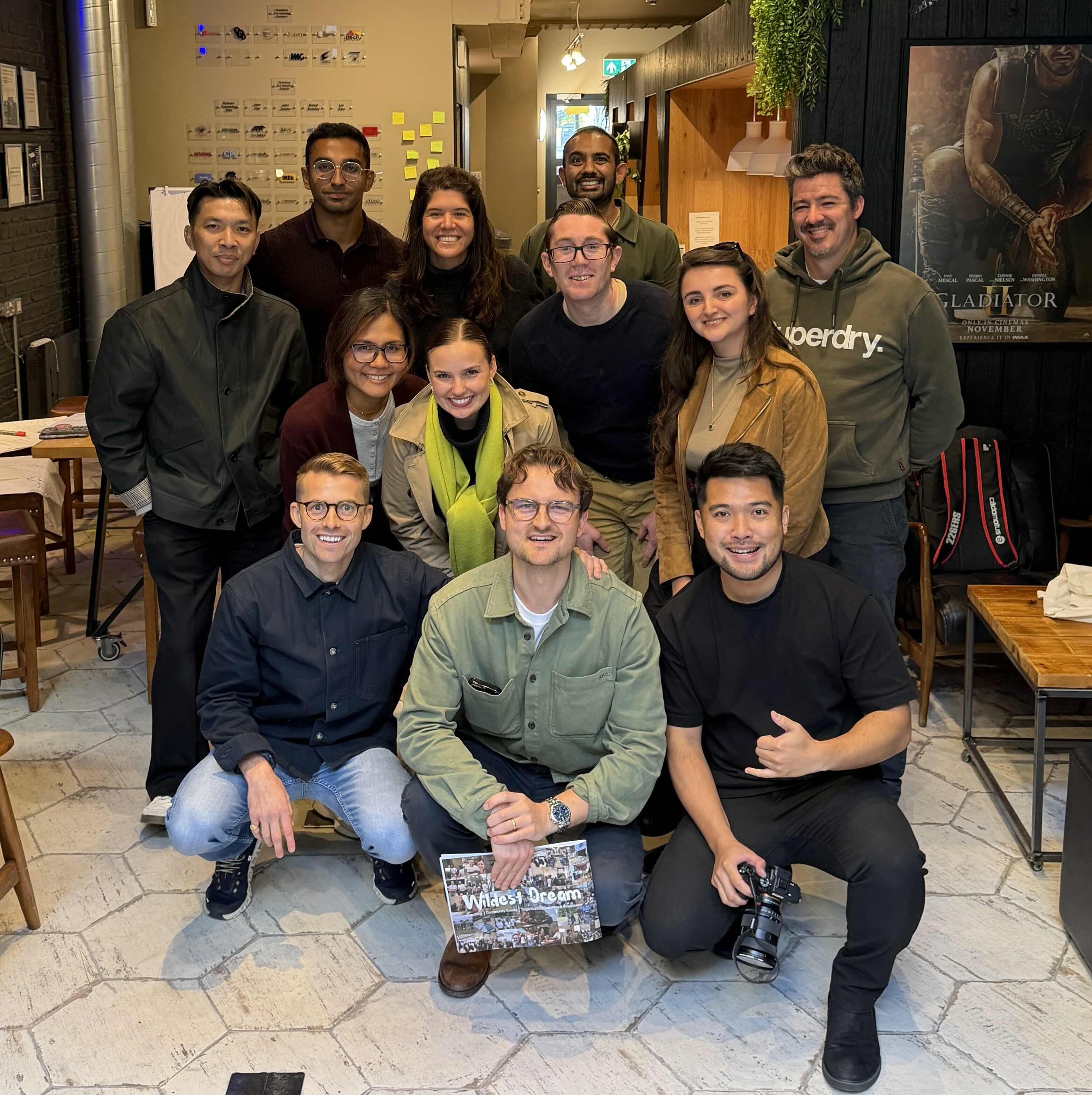
Helping our Wildest Dream community get clear on their strengths.
Here is a simple test to distinguish between a competency and a strength. Think about the last time you finished a piece of work and thought: I cannot wait to do that again! Not because someone praised you, but because the process itself left you feeling alive. That is a strength and you should lean into it.
Now think about the last time you finished something, delivered it well and your first thought was: thank God that is over! That is a competence and we should beware building a career around it.
But if you do build your career around competence, you will eventually hit a ceiling. Not a skills ceiling - an energy, motivation and drive ceiling. You will get to a point where you are technically capable of doing more, but you simply do not have the drive to.
Your challenge this week
And so, here is my challenge to you for this week. To first step back and think of 3 tasks within your role that you are competent in but that leave you feeling drained, and 3 tasks that energise you and leave you feeling strong.
Now, I want you to look at those 3 competencies and ask yourself: what opportunity is there to delegate, automate or redistribute amongst the team one of these tasks? Then, I want you to take your 3 strengths and ask yourself: what opportunity is there to do more of these within my role?
And, if you really want to build a deep understanding of your strengths, I’d always recommend taking the Clifton Strengths assessment (linked below).
A final thought
Sure, we will never enjoy 100% of the tasks that we do within our role.
I consider my job to be incredibly fulfilling and there are still parts of it that I just have to grin and bear. But I believe we should try at least to do a little more of what lights us up each week and, where possible, a little less of what drains us.
Because life’s too short and work takes up too much of that time, for us to allow years to pass without engaging in work that lights us up, that makes us feel alive.
Deepen Your Curiosity
Take the CliftonStrengths assessment - it is the starting point for every strengths conversation we have with clients and seeing your top five in black and white is a genuine lightbulb moment.
Marcus Buckingham’s Go Put Your Strengths to Work is a classic and a great read if this blog struck a chord. It covers the philosophy and psychology behind the strengths movement, as well as being packed with practical steps for spending more of your week in your strengths zone.
