
Why talking about purpose with your high performers is a smart move to make
Your purpose is your reason for being
In the last twenty years, purpose has become a hotter topic. Since 2004, the relative number of Google searches related to purpose has quadrupled. Alongside that, we are now awash with books such as Start with Why by Simon Sinek and Ikigai by Garcia and Miralles. Whole industries (such as ours) now exist to coach people towards a life of more meaning and purpose.
But, before we begin, what even is purpose. I love using the concept from Japan, your Ikigai. In Japan they define that as: your reason for being.
If you’d like to go into more detail about what purpose is, you can read it here, or check out the book review of Ikigai here.
Of course we think this is great. But one thing that does worry us is the lack of purpose based discussions at an organisational level. We don’t see a whole lot of evidence of managers asking their teams: what’s your purpose?
I think there are a couple of reasons for it:
It’s a very lengthy discussion to have, with no immediate pay off or clear answers.
Managers are often scared that their team members will have a lightbulb moment, realise working for their manager isn’t their purpose and abandon ship!
Let’s address point two first, then later in this article I’ll give you some tips on point 1.
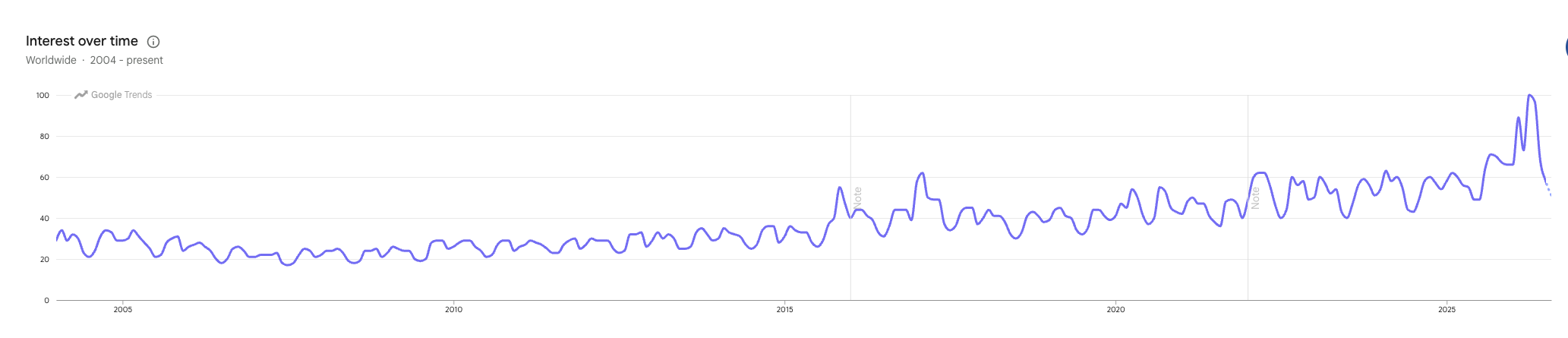
Google Search Trends indexed for Purpose - 2004 until July 2026. Since 2004 the interest in ‘purpose’ has roughly quadrupled. The data is indexed, meaning takes into account the growth of Google in general - i.e. we are seeing the relative growth of purpose related to all other Google search terms.
Your highest performers are already thinking about it
Look at the chart above. The highest performing individuals in your team are already thinking:
What’s my purpose
How do I figure out my purpose
Does this company connect to my purpose
They’re thinking those things because (1) they’re smart; and (2) they know that to thrive in this world, they need to connect to the reason behind why they’re doing their work.
So please, don’t avoid the elephant in the room - address it head on and have that tough conversation. The upside is huge - think about it this way. How important is “your reason for being” or your purpose. It’s massive, right? How connected do we feel to people who are willing to talk to us about the most important things in our lives, hugely! Let me repeat - if you have this conversation with your team, you will begin to earn a deep loyalty from them that you just can’t buy.
Here’s the questions you can ask in your next development catch up
You want to structure this conversation into two parts: (1) who are you; and (2) where are you going and (3) purpose. I will give you a flow of questions which you can use, but please feel free to tweak them!
Who are you
What are your values? What do you believe in? How do you connect to the company values?
What are your strengths? What makes you unique? What company priorities are best suited to your strengths?
Where are you going

Jack and Pat talking ‘who are you’.
What are the most important areas of your life? Both personally and professionally.
How does your career contribute to your life being fulfilled?
Where do you see yourself in 12 months, in 2 years? Is there someone in the company whose job you’d love to do?
Your purpose
What made you join this company in the first place?
What are the themes when you consider your answers to ‘who you are’ and ‘where you’re going’?
Have you thought about what your purpose might be?
Can I help you explore what your purpose is?
If you have this conversation with your highest performers, I guarantee you one thing: your team will surprise you by how connected they feel to both you and the organisation.
Top tips:
I recommend that you have this conversation over a couple of catch ups, because it will allow your team member to really think about it and come back to you with something concrete.
Pre-send these questions over email three days before the catch up and ask for some draft notes of what they’re thinking. Nobody likes surprises - least of all with questions as deep as these!
The smartest leaders find ways to integrate
If you really listen to your team member, you’ll start to see patterns emerging across what they’re saying. When you build this picture of ‘who they are’, ‘what they want to achieve’, ‘why they want to achieve that’ - you will be able to help them integrate both their personal journey with the career journey.
Easy? No.
But worth it? Yes.
If you’re interested in how we help teams connect more to their own and their company purpose, get in touch.
