
How to understand your team’s strengths
It’s not new news - developing your team’s strengths provides a huge opportunity for growth
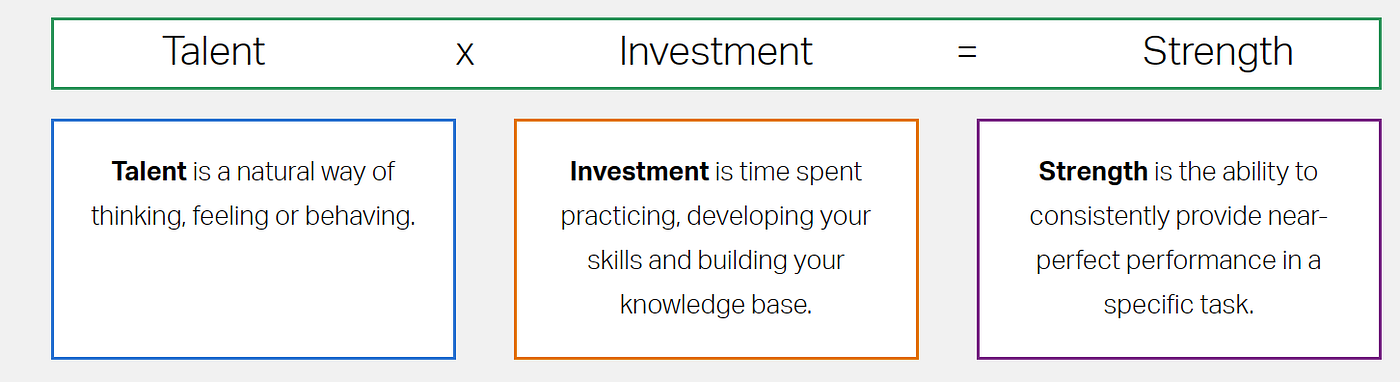
If you’re a high performer, you know this already, but those teams which perform better than others do so because they have a deep focus on their strengths. Gallup are the world leaders in organisational strengths practice. In their language, a strength is the ability to consistently provide near-perfect performance in a specific task.
It sounds easy, right? Take your strengths and apply them consistently, and you’ll have perfect performance. Well, what if we don’t know what our and our teams’ strengths are?
+18% Engagement
+23% Sales
+18% Profitability
-70% People Turnover
+18% Engagement +23% Sales +18% Profitability -70% People Turnover
*These statistics are commonly cited on Gallup’s website - whilst the exact number might vary year after year, the impact is the same: strengths drive business performance.
But first, why do we care so much about strengths at Wildest Dream?
Put simply, the world is changing faster than ever. If we end up working on things that we are merely ‘good’ at, then we will be left behind by those high performers who are devoted to what they are ‘great’ at. Both Patrick and myself had the privilege of working for managers who had a strengths-based philosophy where we were given opportunities to focus on those activities that lit us up, rather than drained us. What’s more, when I lead teams at Kraft Heinz, one of the first things I understood with each team member was, “what are you great at?” Once I knew that, I was able to deploy them in such a way that success was (almost) guaranteed.
You might have heard of Clifton Strengths as the easy route into building a strengths culture within your team. However, it isn’t the only way. In the article below I will lay out an alternative that will cost just £15 for the whole team.
If you want to read more about my own personal experience with strengths, check out this article I wrote a while back.
37 million people have taken it for a reason
Clifton Strengths 34 Assessment
What is it and how much does it cost?
Clifton Strengths is a psychometric assessment which takes about 25 minutes to complete and gives you a list of 34 talents ranked in order of relevance for you.
For example, Jack’s dominant (Top 5) talents are: Communication, Relator (enjoys 1:1s), Activator (likes to get started), Maximiser (nice word for perfectionist), and Ideation. It will give you this list with unique descriptions for you. For example, if you and a colleague both have Communication as the number one talent, it will read totally differently.
With this report, you will be given detailed feedback on:
What makes you uniquely gifted
How you can turn those gifts into action
What weaknesses (or blindspots) you need to watch out for.
It costs either £25 or £55 - depending whether you want to view just your Top 5, or the Full 34 in ranked order.
Wait, what’s all this about strengths and talents?
Yes, it is quite confusing, so check out Gallup’s own definition below.
Do I need a coach to take me through it?
No, you really don’t. You just need to embody the coaching mindset which is beautifully laid out in Michael Bungay Stanier’s The Coaching Habit. You can read the full book review here.
How to avoid it being just another assessment that sits in your download folder
We recommend taking these steps:
Running an introductory session with your team on why strengths are important
Every team member taking the assessment
Doing a 3h workshop together to understand each other’s strengths
Doing a 2h workshop to build a specific action plan on how your team’s strengths will address a particular business challenge
Checking in with your team in your regular 1:1s after the workshop about yours and their strengths
Should I get the Full 34 or just the Top 5?
Many companies will purchase the Top 5 for two reasons:
It saves a lot of money to spend just £25 versus £55
It can be overwhelming to see a list of 34 new talents
All I would say to that is, (1) the benefits of embedding strengths in your team will far outweigh the costs; and (2) with a good introductory session, the team will only have more questions than answers if they only see the Top 5.
Final recommendation: if budget permits it, do the Full 34.
What are some questions I can use to embed this in my team?
We made this handy workbook which you can use with your team - use it in the 3h understand workshop we mentioned above.
Our top tip:
We don’t like to do Clifton Strengths Assessments in a vacuum. For example, if an organisation we are working with are having a communication challenge, then we will base our strengths session around “how to improve your communication through strengths?”
🚨 Now here’s the tip - give this prompt to AI: I am running a Clifton Strengths workshop with my team. I want us to collectively improve our [insert skill name here] using the Gallup Clifton Strengths. Please can you give me one reflective question for each of the 34 Clifton Strengths, split up into the four domains, and write it as a bullet point list that I can put into an A4 size document.
The £15 solution - buy the book and do the exercises in your next 1:1 meeting
Go Put Your Strengths to Work by Marcus Buckingham
I can’t tell you how many times I went back to this book during my managerial career at Kraft Heinz. As managers it is becoming more and more common that we should focus on our team’s strengths, as opposed to their weaknesses. But how should we do it?
Ask these four amazing questions of your new team in your next one-to-one meeting:
Success: where have you had success in your career?
Instinct: what activities seem to come naturally to you?
Growth: where does learning come easy to you?
Need: what activities do you feel like you have to do?
Read the full book review here.
The final word on strengths
The mindset is more important than the method
Look, strengths tests in organisations are becoming more and more popular by the day - which is great - but they are far too often used as an engagement exercise, as opposed to a mindset shift exercise. Yes, it can be a fun thing to do on an away day, but it’s much more valuable to have it embedded in workshops and 1:1 routines between manager and employee.
What’s next?
If you’re interested in how we help future leaders understand and deploy their strengths, get in touch or download our free workbook to understand your team’s Clifton Strengths.
