
The Self-Help Trap
Summary
How by chasing self-improvement we can end up subconsciously self-sabotaging and what to do about it:
I learnt first hand how the pursuit of a high-performance life can tip into unhealthy self-obsession
Having your habits dialed in and still feeling like something's missing, is a sign you've hit your self-improvement ceiling
The happiest people, are the ones whose attention flows outward, not inward
The fix isn't a new habit - its acts of service, done repeatedly, with nothing expected in return
Keep Reading
The mistake I made
There is a trap when it comes to “self-help” and the clue is in the name. In the pursuit of self improvement there is a danger of becoming overly focused on ourselves, which can result in an unhealthy degree of self-obsession.
For us driven folk, this game of growth can - if we let it - become a selfish one. I know for myself, reflecting back now to the start of my journey, that I was at times very selfish in my pursuit.

I was always making sure my sleep score was on track
I would at times wrongly promote my needs above others, thinking that it was necessary in order for me to be at my best. Instead of thinking more about what those around me needed or wanted, I was focused more on what I wanted and what I believed I needed.
I would make sure above all else that I was getting my 8 hour sleep opportunity window and had time for my morning routine, even if that meant it was at the inconvenience of others.
Hitting the wall
I then got to that place where many get to after a few years in this self-improvement game: we have the healthy habits dialed in, we’ve got our morning routine down to a T, we’re in a great rhythm with our nutrition, sleep and movement, we are hitting our targets at work, and yet we feel like something is missing.
I then, as so many others who arrive at this crossroads do, told myself that the something missing must be another healthy habit which needs adding to the stack. I then added bedtime journaling to my daily routines. But that didn’t fix it. I then dived deeper into my Oura app and into my body data, convinced that therein would lie a problem which could explain this feeling. All scores optimal, no issues found.

In this self-improvement game, you might find that at some point you hit a wall and find something is missing.
You see, something that I have since come to realise is that self-enhancement has a ceiling and once we are at or close to that ceiling, it isn’t a new healthy habit or a 2% increase in our sleep score which we need. What we need is to progress from self-enhancement to self-transcendence.
How to climb over
That is, to turn our attention away from ourselves and onto other people. Because, the sad irony is, in looking to self-improve we are often self-sabotaging by becoming so self-obsessed. And, the more that we think about ourselves, the less happy we become. Because a self-centred attitude where the world revolves around you, breeds insecurity, fear and vulnerability. Our survival instincts are amped up - everything and everyone becomes a potential threat to us having what we want and what we need.
But we can’t just say to ourselves: “from today, I will think about myself less”. You’re still thinking about yourself, see? What we need to do instead is get out there and into the world, to actively focus on and give our time, energy and attention to others, which has the beautiful side effect of taking our attention away from ourselves. In this way, service becomes the perfect antidote to self-obsession. As we start to give to others, the ego begins to quieten.
A caveat
But, before we go further, an important caveat because I don't want you finishing this lesson and cancelling all of your therapy sessions to go volunteer at a soup kitchen. There is a balance here.
As a wise man once said: a person who teaches goodness to others while neglecting their own soul, is like an oil lamp that illuminates everything around it while burning itself out.
Your capacity to serve relies on you ensuring that you first look after yourself. You can't pour from a cup you haven't yet filled. First get your habits good enough, your energy strong and your focus dialed in. Then, once that foundation is in place, it’s time to look beyond yourself.
Let your attention flow outward
Professor Laurie Santos, who has spent her career studying happiness at Yale, has found that the happiest people share a common trait: they are other-oriented. Their attention flows outward.
Now, think about the times you've felt most anxious, most stuck, most in your own head. I'd bet good money that in most of those moments, your attention was turned entirely inward. “What will people think of me? Am I doing enough? Am I behind?” The ego is a relentless, needy narrator and the more energy we give to it, the louder the voice of that narrator becomes. Service interrupts that loop and, for a moment at least, the story stops being about you.
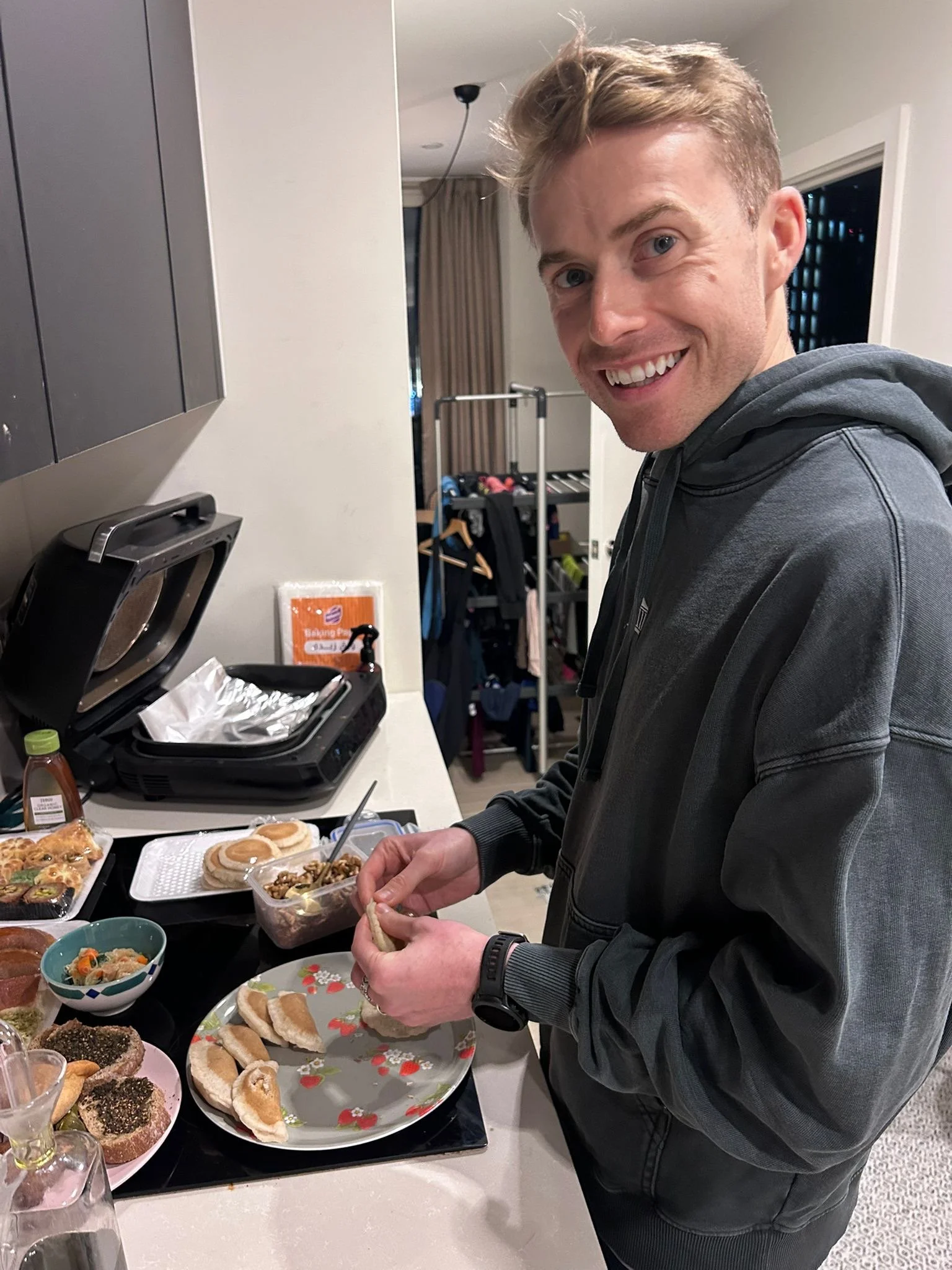
Sometimes doing something for someone else can be as simple as cooking a meal for a loved one.
“If you cling to your life, you will lose it, but if you give up your life for others, you will find it.” Jim Murphy
This doesn't mean abandoning ambition or ceasing to care about your own growth. It means actively doing just a little more for other people. It is to act a little less from the ego (self-enhancement) and a little more from the heart (self-transcendence). Because when we act from the heart, it drives us to do things for others, which, paradoxically, ends up being the best thing that we could do for ourselves.
Too much self-centred thinking is the source of our suffering. A compassionate concern for others is the secret sauce to happiness. And a truly meaningful, purposeful life never has us as the individual at the centre of it.
My challenge to you
And so, here’s my invitation for you this week, and it isn’t to sell all of your possessions and go work in an orphanage, it’s something small and immediate. It’s to commit to just one small gesture - a meal cooked for your partner, a phone call to your Mum, a surprise coffee delivered to a colleague’s desk, a meal deal bought for the homeless man outside your office.
A small something done by you for someone else, with no expectation of anything in return. Because, that is the magic to mastering self-improvement: to realise that it was never really about you in the first place.
Deepen Your Curiosity
Want to hear more from Dr Laurie Santos - the Yale happiness professor? I'd highly recommend this podcast episode when she joined Rich Roll to unpack why our instincts about happiness are so often wrong and why being other-oriented is the most powerful lever that we have.
If you have a couple of minutes now, I would highly recommend watching this short advert which beautifully brings to life the essence of this week’s blog in one of the most heart-warming pieces of content I have ever seen!
