
Why More Is Never Enough
Summary
Chasing and getting more won’t make you happier, it’s time for a new strategy:
We didn’t evolve to be happy - we evolved to be constantly dissatisfied
This dissatisfaction was essential for our survival as a species
But today it is the root cause of your inability to be content with what we have
Buddhism and Stoicism both point to the same fix: want less instead of chasing more
Meet John
Happiness - why is it so bloody hard to grasp and then, when we do taste it, why is it so fleeting? This is due to the simple fact that we did not evolve to be happy and that emotions are not designed to last. Let me, as you might have now noticed I like to do, take you back to the time of our hunter-gatherer ancestors to explain.

A snails pace: our genes are 98% the same as our hunter gatherer ancestors.
Meet John - the happiest, most content member of the tribe. You would look at John and think: "I want to be that guy." But his fellow tribes people don't quite see it that way. "Where's John?", asks Clive, as he is sat by the campfire sharpening his tools in preparation for tomorrow morning's hunt. "He's not meditating on that rock again is he? That guy. Absolutely useless! Sits there content with life while we are slaving away doing all of the work around here. What value does he actually bring? None I tell you, none!"
Clive's got a point. You see, John being so happy and content with life means that he doesn't have the same inner drive to fight, strive and build a better life for himself, his people and their species, because he is perfectly content with life just as it is. And anyone who is not pulling their weight around the camp? Well, we know what happens to them.
Evolution doesn't care if we're happy - it cares if we survive, reproduce, and pass on our genes. Happiness does not support any of that. In fact, happiness actually gets in the way of those very things, for the precise reason mentioned above. And so, it is not only that we have not evolved to be happy, but that we have actually evolved to be dissatisfied with what we have. Because that dissatisfaction, unease and insecurity are what has driven our species to where we are today.
"We suffer (psychologically) for the simple reason that it is biologically useful, it is nature's preferred agent for inspiring change."
Mark Manson
These emotions, like all others, are signals designed to nudge us towards or away from certain behaviors and signals, by their nature, aren't designed to last. That is why the rare moment of bliss - of genuine contentment and peace - after achieving a goal, evaporates so quickly. Because emotions are designed to come and go - it is just what they do.
"But Pat", you might be thinking, "this was 100,000s of years ago, surely evolution would have fixed this by now?" Not quite. We as a human species have been living on this earth for around 200,000 years, we have only had cars, electricity and running water for 0.08% of that time.
Evolution moves at a glacial pace and that is why our genes are still 98% the same as our hunter-gatherer ancestors, and why we, as Anders Hansen puts it in The Attention Fix, "despite living in a digital society ... still have a hunter-gatherer brain."
The biological mechanism of being constantly dissatisfied with what we have, has helped us survive for 99.9% of our time as a species on this earth. It is only relatively recently in the context of those 200,000 years, that we as a species have got to the position where we don't need to be constantly dissatisfied with what we have in order to survive, and that we would probably be better off being a little less spoilt and more grateful for what we do have, instead of constantly chasing more.
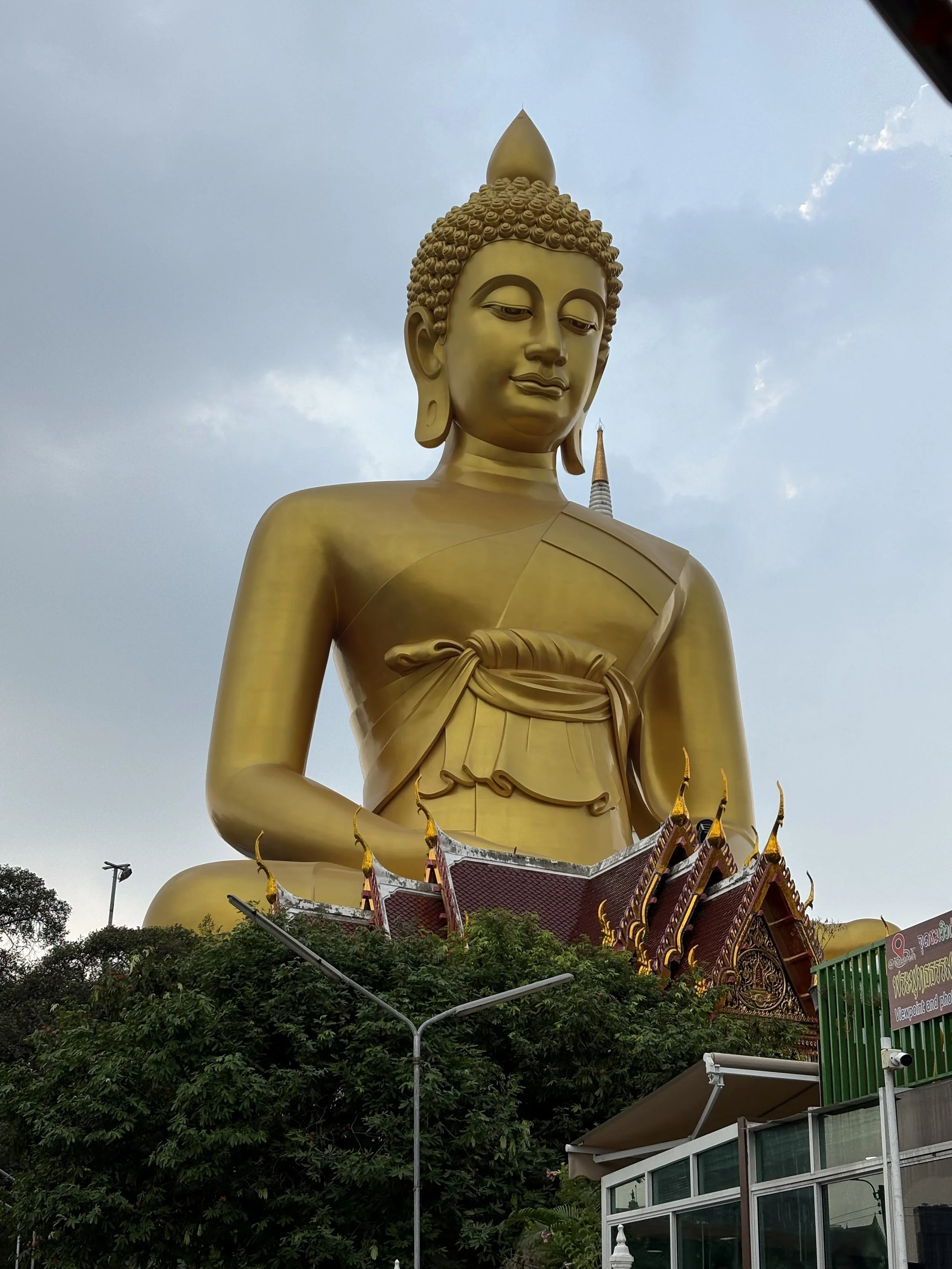
Dukkha refers to the ‘suffering’ or ‘unsatisfactoriness’ of life. A person might temporarily fulfil their desires but suffering – whether physical, emotional or mental – cannot be avoided.
That constant chasing of more is called "the want brain" and it is what tells us today that more is better, that in order to be happy, we need more. More money, more status, more power, more social media likes, more [insert whatever you want here]. But this isn't a new discovery. Buddhists have known this for a long time. The first noble truth of Buddhism after all is that life is "dukkha" - suffering, or more accurately interpreted as "dissatisfaction."
And so, this is the conundrum that you and I face today: we have inherited a brain which wants us to be constantly dissatisfied, meanwhile we are scratching our heads as to why we are never satisfied. "We've got the job, the house, the money, holidays and good health, what more do we need?"
The default next step taken by many, unconsciously driven by their want brains, is to then think that we aren't happy because we don't have enough and so therefore we go out there to get more. And so the cycle continues. But, as we now know, the source of our unhappiness isn't the absence of what we want - it's dissatisfaction with what we have.
Try something different
So maybe it's time we tried something different? Take this advice from the philosopher and modern day Stoic William B. Irvine:
In order to be happy, we don't need to fulfill our desires, but instead we need to change our beliefs and ideas. Specifically, our beliefs and ideas about what we have and what we "need" in order to be happy.
Here is a simple formula which I think might help:
Happiness = Haves / Wants
If we can decrease our wants and begin to appreciate more what we have, we increase our happiness.
"It isn't what one has that constitutes wealth, it is to be satisfied with what one has - that is wealth."
Epictetus, Roman Stoic
Now, we cannot completely re-wire our brains and fast track the evolutionary process to reengineer our genes to make us happier. But, what we can do is this: first to recognise that wanting and getting more isn't the solution to the dissatisfaction problem we have; then to be more grateful for what we do have.
A simple daily gratitude practice has been scientifically proven to nudge you in the direction of beginning to more often see and appreciate the beauty of your life as it is. And here is a style I've adopted more recently, after recently hearing Shawn Achor, author of 'The Happiness Advantage', speaking on a podcast:
Each morning sit and write down 3 things that you are grateful for in the last 24 hours.
I have found this "last 24 hours" part to be key for two reasons: a daily gratitude practice can become repetitive and lose its potency if we are always writing down the same things each day; and the psychological boost doesn't come from the actual writing down of the 3 things, but in the scanning - in actively thinking about yesterday and all of the good in it.
Look, I believe that we should strive to make our lives and the lives of those around us who we love and care for better. But falling into the trap of continually wanting and chasing more, while being blind to what you have right in front of you, is a sure fire way to living a life of dissatisfaction and unease. A shame don't you think, considering we only have one?
Deepen Your Curiosity
Mark Manson's The Subtle Art of Not Giving a Fck* is one of the best books I've read in recent years, it’s a best seller for a reason. Super pragmatic and genuinely useful when it comes to understanding our brains and how to better manage them.
Anders Hansen's The Happiness Cure brilliantly breaks down in simple terms evolutionary biology and shows how we can actually become happier in this strange world that we live in.
